
Short Courses
Short Courses & Executive Training
AI and Deep Learning, taught through a statistician’s lens
Customized short courses for companies, government agencies and professional societies — from a half-day executive briefing to a multi-week technical program. Each topic is built on ideas your team already trusts: regression, likelihood, uncertainty and honest evaluation. Participants leave knowing not only how modern AI works, but when to trust it.
Why this course
Beyond the hype: AI your team can understand, evaluate and trust
Most AI training teaches tools that change every six months. These courses teach the ideas that don’t — so your people can make sound decisions long after the course ends.
The statistical lens
Clarity instead of jargon
Neural networks are regression, training is maximum likelihood, and attention is a kernel smoother. Seen this way, deep learning becomes intuitive for analysts, engineers and managers alike.
Rigor and trust
Know when the model is wrong
Uncertainty and error bars, validation, distribution shift, adversarial examples and how to verify AI-generated results — the questions that matter before an AI system goes into production.
Current and practical
Updated for 2026
From CNNs to Transformers, diffusion models and AI agents, with real examples, short code, and workflows participants can use the week after the course.
Formats
Choose the depth that fits your audience
Every engagement is customized: modules, examples and exercises are selected for your industry and your participants’ background.
EXECUTIVE BRIEFING · HALF DAY
AI for Leaders
Executives, directors and managers · no technical background needed
What AI, generative AI and agents can and cannot do; how to read vendor claims; where the risks are; and how to build an AI-ready team. Interactive and case-driven.
TECHNICAL WORKSHOP · 1–2 DAYS
Deep Learning in Depth
Data scientists, engineers, statisticians and analysts
Two or three modules in depth, with worked examples, short code demonstrations and optional hands-on labs. Ideal as an intensive on-site workshop.
MULTI-WEEK PROGRAM · 4–8 WEEKS
The Complete Curriculum
Technical teams building long-term AI capability
All five modules in weekly sessions, on-site or live online, with discussion of problems from your own organization and optional capstone projects on your data.
CONFERENCE SHORT COURSE · HALF OR FULL DAY
For Professional Societies
Statistical, engineering, quality and biomedical meetings
Delivered at JSM 2025 and 2026, ENAR 2026 and ICSA 2024. Available for other society meetings and continuing-education programs in statistics, quality, reliability, industrial engineering and biomedicine.
Course Modules
Five modules, mix and match
Each module stands on its own (about 3 hours) or combines with others into a longer program. Participants receive the full slide deck; a sample slide from each module is shown below.
MODULE 01 — FOUNDATIONS
A Statistical View of Deep Learning
Regression, likelihood and regularization at scale. We build a neural network from logistic regression one step at a time, then explain how networks learn and why huge models still generalize.
- Neural nets as regression
- Gradient descent & backprop
- Double descent
- Regularization
- Architectures
- Uncertainty
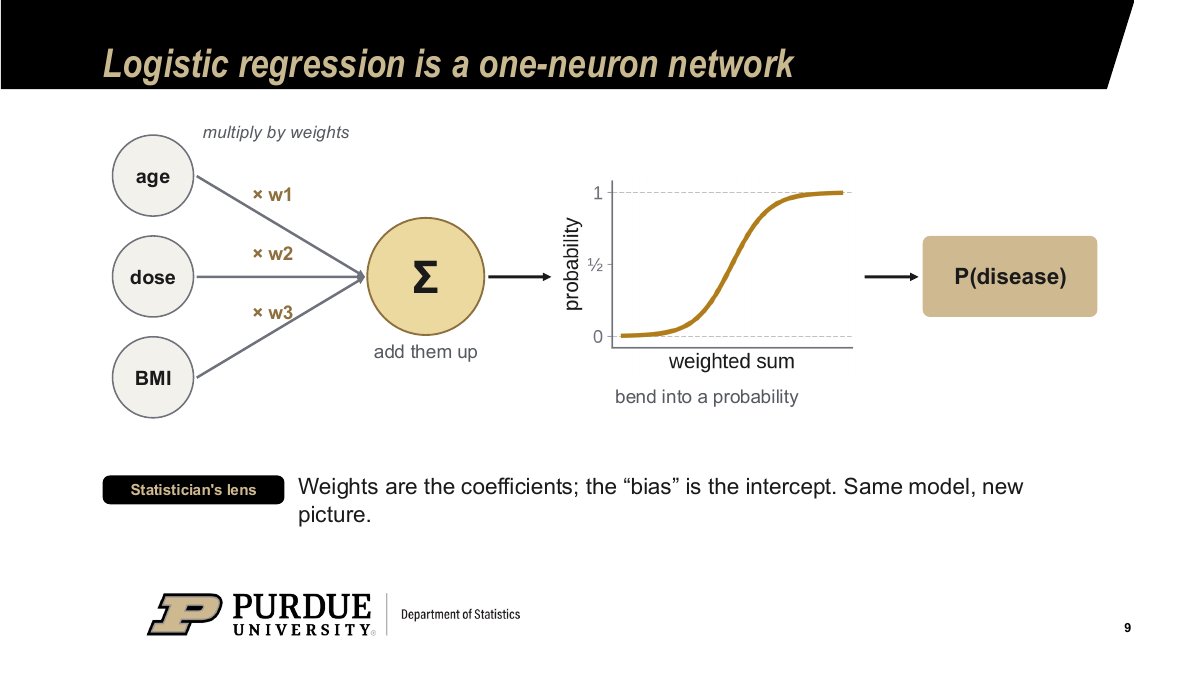
Sample slide · Logistic regression is a one-neuron network
MODULE 02 — COMPUTER VISION
Convolutional Neural Networks: How Computers Learn to See
Convolution as a sliding weighted average, the landmark networks from AlexNet to ResNet, and what it takes to make CNNs work in practice — plus detection, segmentation, and whether we can trust what a model sees.
- Convolution & pooling
- ResNet
- Transfer learning
- Object detection
- Segmentation (U-Net)
- Adversarial robustness
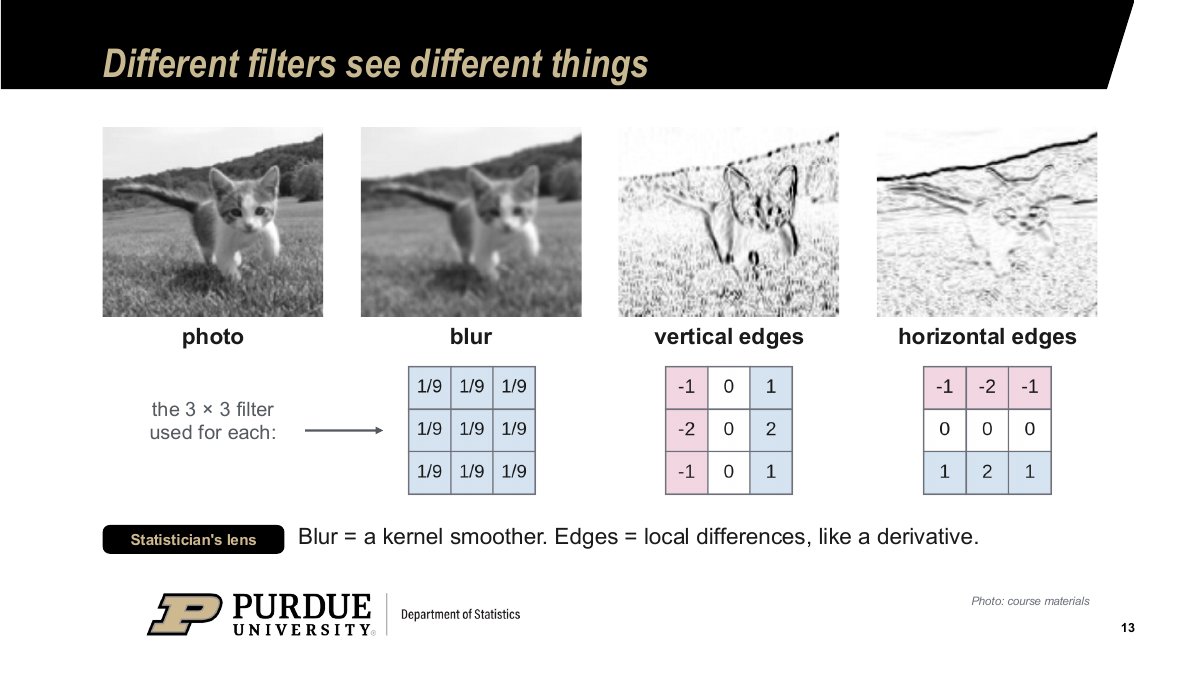
Sample slide · Different filters see different things
MODULE 03 — GENERATIVE AI
Generative Models: How Machines Learn to Create
Every generative model turns simple random noise into realistic data. We cover VAEs, GANs, normalizing flows and diffusion models, text-to-image generation, and how to evaluate and use generative models as statistical tools.
- VAEs
- GANs & Wasserstein GANs
- Normalizing flows
- Diffusion models
- Text-to-image
- Synthetic data
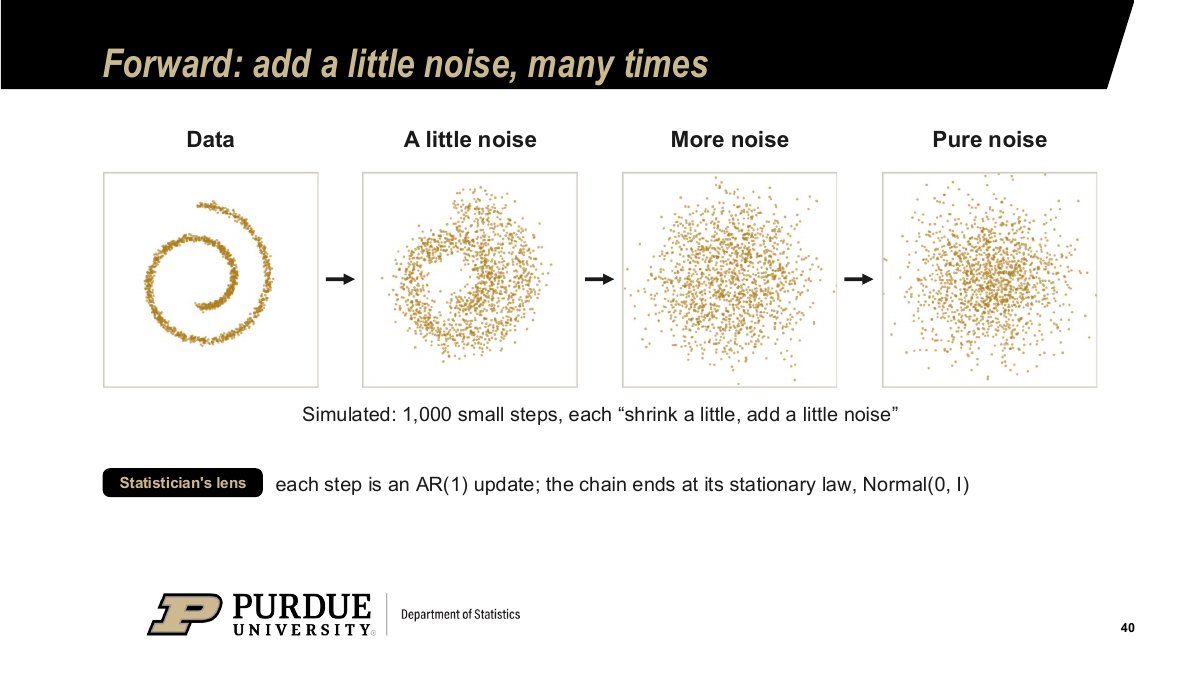
Sample slide · Diffusion: add a little noise, many times
MODULE 04 — LARGE LANGUAGE MODELS
Attention and Transformers: The Engine Behind ChatGPT
From tokens and embeddings to next-word prediction, attention as a learned kernel smoother, the Transformer architecture, scaling laws and human feedback — and why fluent is not the same as correct.
- Tokens & embeddings
- Attention
- Transformer blocks
- Scaling laws
- RLHF
- In-context learning
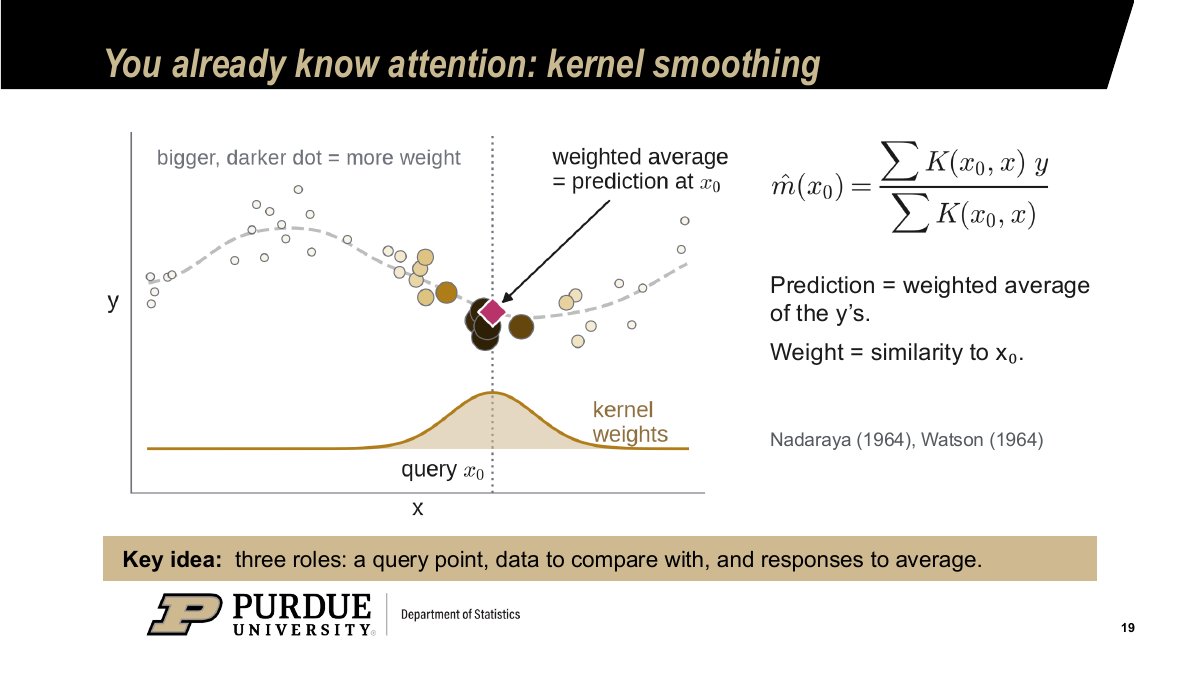
Sample slide · Attention is kernel smoothing
MODULE 05 — AI AGENTS New
A Different Way to Do Research and Analytics with AI Agents
A chatbot talks; an agent acts. A practical, eight-step workflow for using AI agents in research and analytics — what they speed up, what they do not, and the checks that keep results honest. Popular with R&D and data-science teams.
- Chatbots vs. agents
- 8-step workflow
- Verifying AI output
- What stays human
- Six rules for safe use
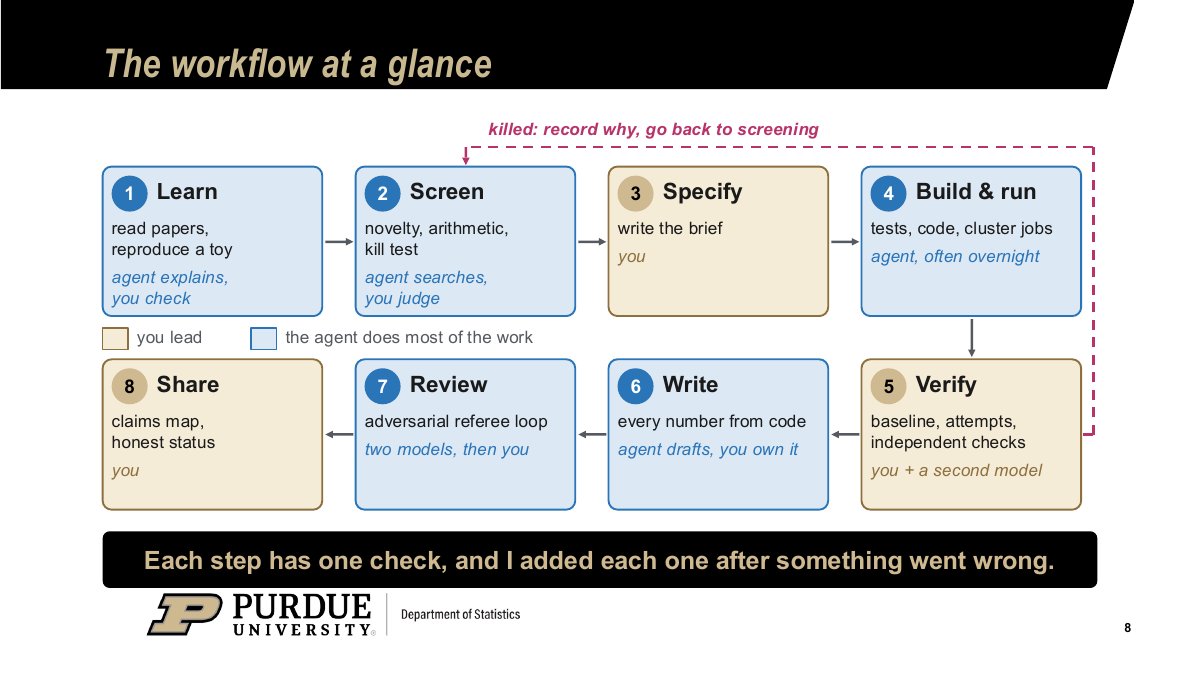
Sample slide · The workflow at a glance
Who it’s for
Built for industry, government and professional societies
Courses are tailored with examples from your field, so participants see AI applied to problems they recognize.
- Manufacturing & reliability
- Pharma & healthcare
- Finance & insurance
- Agriculture & food
- Technology
- Government & defense
- Professional societies
Your instructor
Xiao Wang
Head, Department of Statistics and J.O. Berger and M.E. Bock Professor of Statistics, Purdue University. He teaches Purdue’s graduate courses in Deep Learning (STAT 695) and Statistical Machine Learning (STAT 598), and his research group develops the statistical foundations of modern machine learning, including deep generative models. He has co-taught deep learning short courses at JSM (2025, 2026), ENAR (2026) and ICSA (2024).
How it works
From first email to delivery
- 01Get in touch
Tell us your audience, goals, preferred format and dates. - 02Scoping call
A short call to choose modules and tailor examples to your field. - 03Proposal
A customized agenda and quote for your engagement. - 04Delivery
On-site at your organization, at Purdue, or live online. - 05Follow-up
Full slide decks, a reading list and optional follow-up Q&A.
Request a course
Let’s design a course for your team
Whether you are planning an executive offsite, a technical training week, or a short course at your society’s annual meeting, we would be glad to hear from you.
Track record
Taught at the field’s leading meetings
With Hongtu Zhu (Kenan Distinguished Professor, UNC Chapel Hill) and Runpeng Dai (UNC Chapel Hill), I have co-taught the full-day short course Deep Learning Methods in Advanced Statistical Problems at the major statistical meetings. Slides, Colab coding sessions and recordings are available on the course website.
AUGUST 1, 2026 · FULL DAY Most recent
JSM 2026 · Boston, MA
Foundations of deep learning, large language models, and generative models (taught by Xiao Wang). Session recordings available.
MARCH 15, 2026 · FULL DAY
ENAR 2026 · Indianapolis, IN
Foundations, computational resources, deep generative models and attention & Transformers (taught by Xiao Wang), and large language models, with hands-on Colab sessions.
AUGUST 3, 2025 · FULL DAY
JSM 2025 · Nashville, TN
Deep generative models and attention & Transformers (Xiao Wang), plus foundations, sequence and spatio-temporal modeling, and LLMs, with Colab coding sessions.
2024 · SHORT COURSE
ICSA 2024
Deep Learning Applications in Statistical Problems, the first offering of the course, co-taught by Hongtu Zhu, Xiao Wang and Runpeng Dai.