Statistics Professors honored with Purdue University Online Awards for Excellence in Online Education
06-29-2026
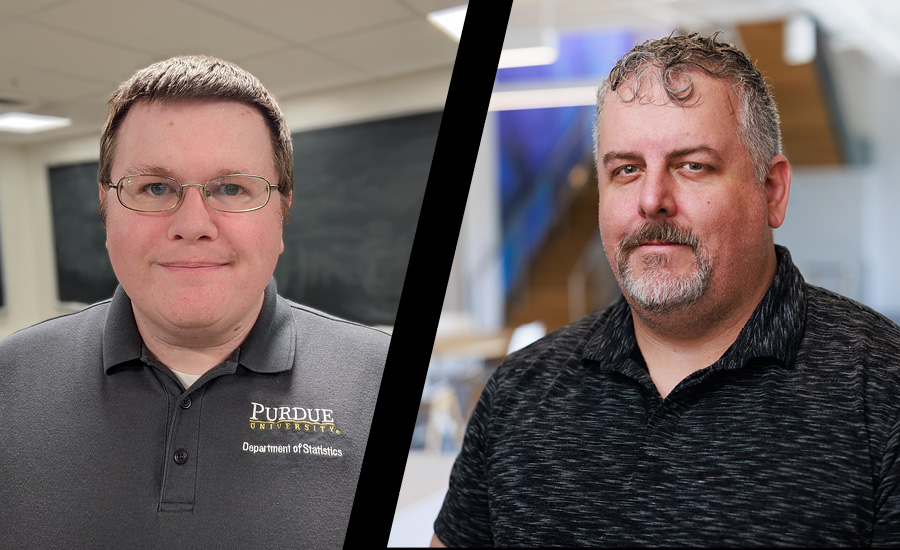
Two faculty members from Purdue University Statistics Department within the College of Science have been recognized with a 2026 Purdue University Online (PUO) Award for Excellence in Online Education. The annual award honors faculty and instructors who demonstrate exceptional quality in online teaching and instructional innovation across Purdue West Lafayette and Purdue Indianapolis.
Timothy Keaton
Timothy Keaton, assistant professor of practice in the Department of Statistics, was honored with the Award for Excellence in Online Education for his support in developing the online offerings in the Department of Statistics, including STAT 513 (Statistical Quality Control), STAT 506 (Statistical Programming and Data Management), STAT 582 (Statistical Consulting) and GRAD 505 (Foundations in Data Science).
“I have been blessed to work with an excellent team from Purdue Online and my department over the last several years, and this program would not be where it is without the contributions of so many others,” said Keaton. “This includes the students, who bring so much to the program. It's great to have all our efforts recognized in this way.”
“Teaching online is just like teaching in person,” said Keaton. “It's all about connecting with the students. That just looks different online, and it will likely look a bit different for each professor. Don't be hesitant to bring your own personality into your lectures and your (regular) updates. And check your email!”
Keaton was born and raised in Indiana. When starting college, he was not sure what he wanted to do, but he knew he liked math and wanted to be able to apply it. After an undergraduate degree and a master’s degree in statistics followed by a few years of teaching, he ended up back in graduate school for his PhD. That last stop was at Purdue University where he has been ever since. He is also an avid board gamer and dabbles in kayaking, pickleball, and filmmaking.
“Statistics lends itself well to being taught online, even in an asynchronous format, allowing students to access material from anywhere in the world,” said Keaton. “This program gives working professionals the flexibility to strengthen and expand their statistical skill set while maintaining full-time employment. Our students bring their diverse experiences and perspectives from across industries to the classes, enriching discussions and broadening perspectives for everyone in the course, including faculty.”
Timothy Reese
Tim Reese, assistant professor of practice, is the STAT 350 course coordinator for Statistics. He was honored with the Award for Excellence in Online Education for his leadership in developing STAT 350 Winter Session (Introduction to Statistics).
“Earning this award means a great deal because it recognizes a conviction I built the Winter Session around: that a fully online, asynchronous course, designed carefully, can hold students to the same standard as any lecture section rather than asking them to settle for a lesser version,” said Reese. “The Winter Session compresses the entire introductory statistics course into a short, fully asynchronous window, which is exactly the format where people tend to assume rigor and engagement fall apart. Building it was really a test of the opposite idea, and seeing it work, then seeing it recognized by colleagues in the online education community, tells me the approach held up well beyond our own classroom. I also see it as a shared accomplishment, since the course reflects the work of instructional designers and the broader Purdue Online team.”
Reese also created STAT 41800, Computational Methods in Data Science. He designs STAT 350 to run across multiple modalities (traditional lecture, flipped classroom, and fully online asynchronous), building materials tailored to each format so that every student can reach the same content in the way that fits how they learn. His teaching leans simulation-based learning, including highly interactive browser apps that let students explore core statistical ideas directly rather than only reading about them. Alongside his teaching, he is Principal Investigator on an NIH-funded research project and works at the intersection of statistics education, bioinformatics, and the responsible use of AI in data science. Outside of work, he powerlifts and practices meditation.
Reese said that he embraces online teaching with a Build, Own, Interact, Lower, and Rely method. This method is outlined by these steps:
- Build more than one path to the same content. In the Winter Session the same material was reachable through a searchable webbook, dozens of short indexed video segments, browser-based simulators, worked-out practice problems with revealable solutions, and a 24/7 course-constrained AI tutor, so each student could take the route that fits how they learn.
- Own the standard. Online and accelerated does not mean easier. Proctored exams, quizzes, and a firm rule that students must be able to explain any work they submit keep the bar identical to any lecture section.
- Interact with concepts. Letting students manipulate a sampling distribution or a confidence interval directly in the browser builds far more durable intuition than telling them a rule of thumb.
- Lower the barriers. Accessibility belongs in the design from the start, not bolted on at the end. It is easier to build in and it makes the course better for everyone.
- Employ AI on both sides of the desk. A course assistant retrieves course materials and can answer questions at any hour, while a clear AI policy and proctored, explain-your-reasoning assessments, protect academic integrity.
- Rely on the people around you and remember not everyone has the same toolkit. Instructional designers, producers, and teaching assistants are real partners. Start from the principle and find the version that fits your own resources.
“None of this means rebuilding your course overnight. It means deciding that an online student deserves the same rigor and the same access as anyone in the lecture hall, then building toward that one piece at a time,” he said.
About the Award
Nominations for PUO Awards may be submitted by deans, associate deans, department heads, school heads, associate heads, academic leads and PUO staff. The call for nominations goes out the first week of April for that year’s award. Nominations are due by the end of the third week of April. Award decisions are made the first week of May.
More information about the PUO Awards can be found in the online awards process document.
About the Department of Statistics at Purdue University
Our mission is to advance the frontiers of statistical sciences and data science in both theory and applications; to provide learning environments that produce well-educated data scientists, statisticians, probabilists, and quantitatively literate people; and to join with others in bringing the strengths of the statistical sciences to address societal needs. The Department offers the degrees of Bachelor of Science, Graduate Certificate, Master of Science, Online Master of Applied Statistics, and Ph.D. in Statistics. Our programs prepare students for careers in both industry and academia and prepare them to be leaders in their fields. The Department of Statistics is part of the College of Science at Purdue University and is housed in the Mathematical Sciences Building in West Lafayette, Indiana. Learn more about the department at stat.purdue.edu.
Contributors:
Timothy Keaton, assistant professor of practice in the Department of Statistics
Tim Reese, assistant professor of practice in the Department of Statistics
Written by: Cheryl Pierce, Purdue University College of Science