How Shlok Sheth built his Purdue experience
07-15-2026
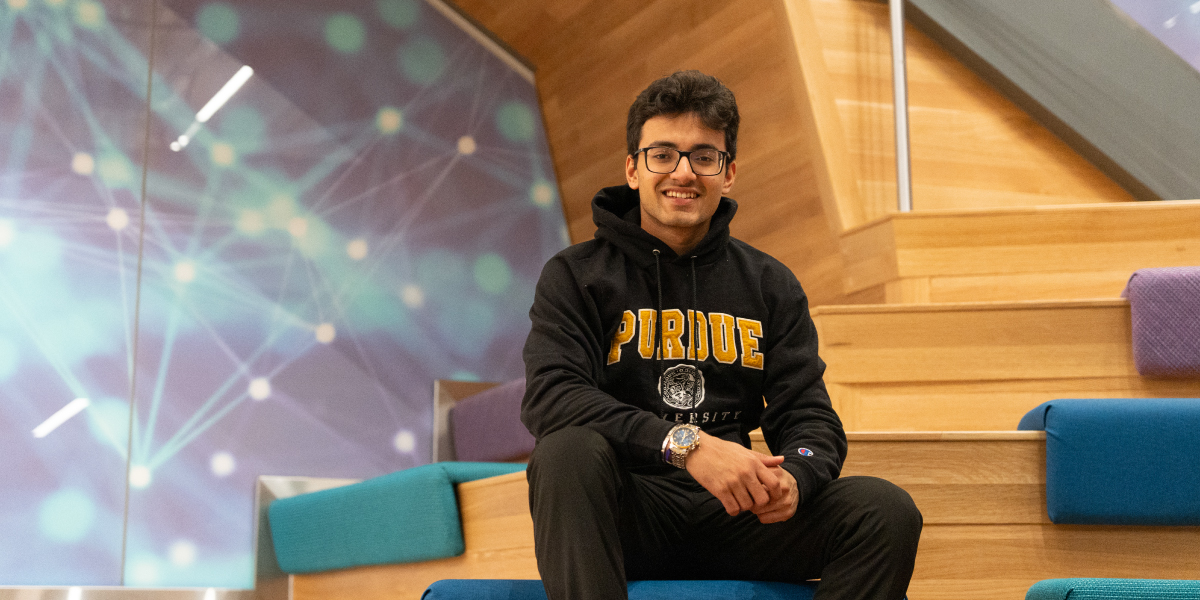
When Shlok Sheth arrived at Purdue University from Oman, he knew he was joining one of the nation's leading STEM institutions. What he didn't know was how many opportunities would emerge once he stepped onto campus — or how quickly he would learn that success at Purdue often starts with taking initiative.
Now a rising senior majoring in data science and applied statistics with a minor in business economics, Sheth has built a Purdue experience defined by research, entrepreneurship, leadership and industry engagement. Along the way, he has discovered that some of the most valuable opportunities come from simply being willing to raise a hand, send an email or start something new.
"I was drawn to Purdue because of its strong research environment and the people here," Sheth said. "Being surrounded by students who are motivated and constantly striving to achieve more really appealed to me."
Growing up in Oman while maintaining strong ties to his Indian heritage, Sheth viewed attending Purdue as both an opportunity and a challenge. Arriving on campus as an international student, he was eager to make the most of every experience available.
That mindset quickly led him beyond the classroom.
During his time at Purdue, Sheth co-founded two student organizations focused on helping students gain practical experience in data science and analytics.
One initiative, Business Data Analytics in Advanced Manufacturing (BDAAM), connected students with manufacturing-focused projects that combined engineering, business and data science. Working alongside Purdue's manufacturing research community, students analyzed industry data and developed insights for real-world applications.
Sheth also helped launch the Purdue Data Exchange, a student organization designed to connect students from a variety of disciplines with community and campus partners seeking data-driven solutions. Through the organization, students gained experience applying classroom knowledge to real-world challenges while working directly with stakeholders.
For Sheth, the organizations addressed a challenge he noticed among many students.
"Students learn a lot in the classroom, but I wanted to create opportunities where they could apply those skills to real problems," he said.
His leadership efforts were complemented by academic opportunities within the Department of Statistics. Sheth served as a grader for a probability course, under the mentorship of Professor Timothy Keaton.
Research has also become a defining part of his Purdue experience.
As a sophomore, Sheth sent dozens of emails to faculty members seeking research opportunities. Most went unanswered. One, however, changed the trajectory of his undergraduate career.
Associate Professor Bowei Xi invited him to discuss a potential project, opening the door to research in machine learning and data analysis.
"That opportunity really compounded into so many others," Sheth said.
Working alongside faculty and graduate student researchers, Sheth became involved in research examining adversarial attacks and Stackelberg games, contributing as a co-author on a manuscript currently undergoing peer review. He also contributed a chapter on large language model jailbreak systems for an upcoming research book, which will become his first published scholarly work.
His research efforts recently earned additional recognition through Purdue's OUR Scholar program. Sheth was awarded an OUR Scholar grant for 2026-27 to support his project, "Foundational Approaches Towards Robust AI," which explores methods for improving the reliability and security of artificial intelligence systems.
Beyond the technical skills he gained, Sheth credits Purdue faculty mentors with helping him better understand his strengths and professional goals.
"They encouraged me to keep learning, but also to identify where I could have the greatest impact," he said.
Those lessons proved valuable when Sheth secured an internship with a New York-based startup backed by Y Combinator, one of the world's most prominent startup accelerators.
Working as a forward-deployed engineer, he collaborated directly with clients while serving as a bridge between technical teams and business stakeholders. The experience gave him firsthand exposure to product development, analytics and startup operations.
The internship also inspired him to develop a tool aimed at helping startups reduce operational inefficiencies and better manage variability in performance metrics.
"It taught me the importance of speed, execution and communication," Sheth said.
The internship also inspired him to pursue independent technical projects. Among them is Experi, a statistical experimentation platform he built on Databricks that combines variance reduction techniques, Bayesian inference and machine learning workflows to help organizations make better data-driven decisions. An article Sheth wrote about the platform attracted widespread attention online and highlighted the practical applications of the tools he developed.
His growing expertise recently earned him another opportunity: serving as an expert contributor for Built In, a technology publication where he shares insights from his experiences in startups, analytics and emerging technologies.
Looking back, Sheth believes Purdue's greatest strength is the combination of opportunity and community.
"The network and connections I've built here have been incredible," he said. "Whenever an opportunity came my way, I tried to take advantage of it and learn from it."
As graduation approaches, Sheth hopes to pursue a career as a product data scientist at a leading technology company, combining analytics, machine learning and business strategy. Longer term, he is interested in research-focused roles in artificial intelligence and potentially launching a startup of his own.
His advice for current and future students is simple: explore widely, then focus intentionally.
"During your first years, try different things and discover what excites you," he said. "Once you find your strengths, invest in them and keep building."
For Sheth, Purdue has provided the platform to do exactly that — transforming curiosity into experience, connections into opportunities and ambition into a growing career path.
About the Department of Statistics at Purdue University
Our mission is to advance the frontiers of statistical sciences and data science in both theory and applications; to provide learning environments that produce well-educated data scientists, statisticians, probabilists, and quantitatively literate people; and to join with others in bringing the strengths of the statistical sciences to address societal needs. The Department offers the degrees of Bachelor of Science, Graduate Certificate, Master of Science, Online Master of Applied Statistics, and Ph.D. in Statistics. Our programs prepare students for careers in both industry and academia and prepare them to be leaders in their fields. The Department of Statistics is part of the College of Science at Purdue University and is housed in the Mathematical Sciences Building in West Lafayette, Indiana. Learn more about the department at stat.purdue.edu
Written by: Alisha Willett, Senior Communications Specialist, amwillet@purdue.edu
Contributors: Shlok Sheth